Quick answer
How much does it cost to self-publish a book? On Amazon, $0 in platform fees, but a professionally produced book typically costs $500 to $3,000. The money goes on editing, cover design, formatting and a launch. A lean DIY book can be done for under $300, while a fully custom book with developmental editing and paid marketing can pass $5,000.
Most guides answer this question with a single, unhelpful range: “anywhere from zero to thousands of dollars.” That’s true, and it doesn’t help you plan. So this guide does what a publisher would do with your manuscript: it prices the book line by line, shows three realistic budgets, and runs the royalty math so you know how many copies it takes to earn your money back.
We help authors publish on Amazon every week, and the same pattern shows up again and again: the authors who overspend usually pay for the wrong things, and the authors who underspend usually skip the two things readers judge first. By the end of this guide you’ll know which is which.
Key takeaways
- Publishing on Amazon KDP is free: no setup, listing or annual fees. Amazon takes its share from each sale.
- Editing is usually the biggest cost, followed by cover design. They’re also the two things readers notice first.
- A realistic professional budget for a first book is $500–$3,000.
- Print-on-demand means no upfront printing bill: the print cost is deducted from each paperback sale.
- Never pay a company that keeps a share of your royalties or publishes on accounts you don’t own.
Self-publishing costs at a glance
Here’s what each part of a self-published book typically costs in 2026. Use the middle column if you want a book that looks professional without overspending.
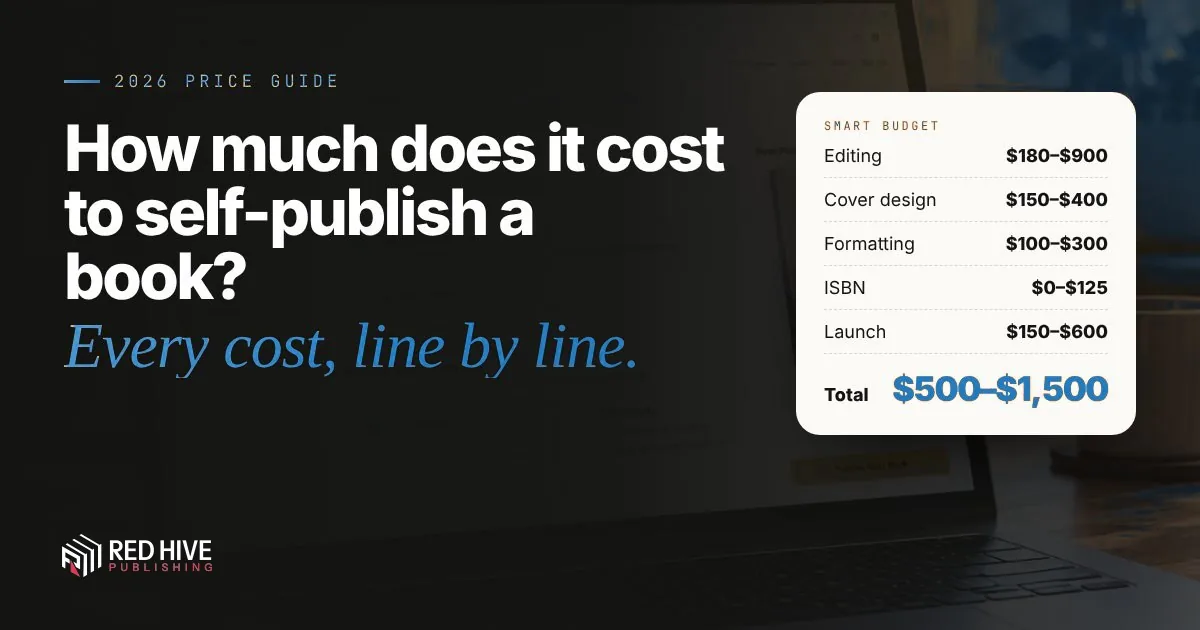
| Cost | DIY | Smart budget | Fully professional |
|---|---|---|---|
| Editing | $0 (beta readers, self-edit) | $180–$900 (proofread or light copyedit) | $1,500–$5,000+ (developmental + copyedit + proofread) |
| Cover design | $0–$100 (template or premade) | $150–$400 (custom ebook + print) | $500–$1,500+ |
| Formatting | $0 (Kindle Create) | $100–$300 | $300–$800 (complex layouts, images) |
| ISBN | $0 (free KDP ISBN) | $0–$125 | $295 (10-pack, your own imprint) |
| Printing | $0 upfront with print-on-demand; deducted from each sale | ||
| Marketing & launch | $0–$100 | $150–$600 | $1,000–$3,000+ |
| Typical total | $0–$300 | $500–$1,500 | $3,000–$8,000+ |
Ranges reflect common US freelance and service rates. Quotes vary with word count, genre, experience and turnaround, so treat them as planning figures, not price tags.
Is it free to publish a book on Amazon?
Yes. Kindle Direct Publishing (KDP) charges nothing to create an account, upload your manuscript and cover, or keep your book on sale. That’s true for Kindle ebooks, paperbacks and hardcovers.
Here’s what you get for free on KDP:
- Publishing and listing on Amazon stores worldwide.
- A free ISBN for paperbacks and hardcovers (ebooks don’t need one; Amazon assigns an ASIN).
- Print-on-demand: Amazon prints each paperback only when someone orders it.
- Free tools such as Kindle Create for formatting and the cover creator.
So where does Amazon make its money? From each sale. For ebooks, you keep a royalty of 35% or 70% depending on price and territory. For paperbacks, you keep 60% of the list price (at $9.99 and above on Amazon.com) minus the printing cost. We’ll run the numbers in the royalties section.
If you’d rather not learn KDP’s settings yourself, a publishing service can handle the upload, metadata and listing for you, as long as the book stays on your own account.
The real question, then, isn’t “what does Amazon charge?” It’s “what does it cost to make a book people want to buy?” That’s where the budget goes.
The 7 costs of self-publishing a book
1. Book editing: $0 to $5,000+
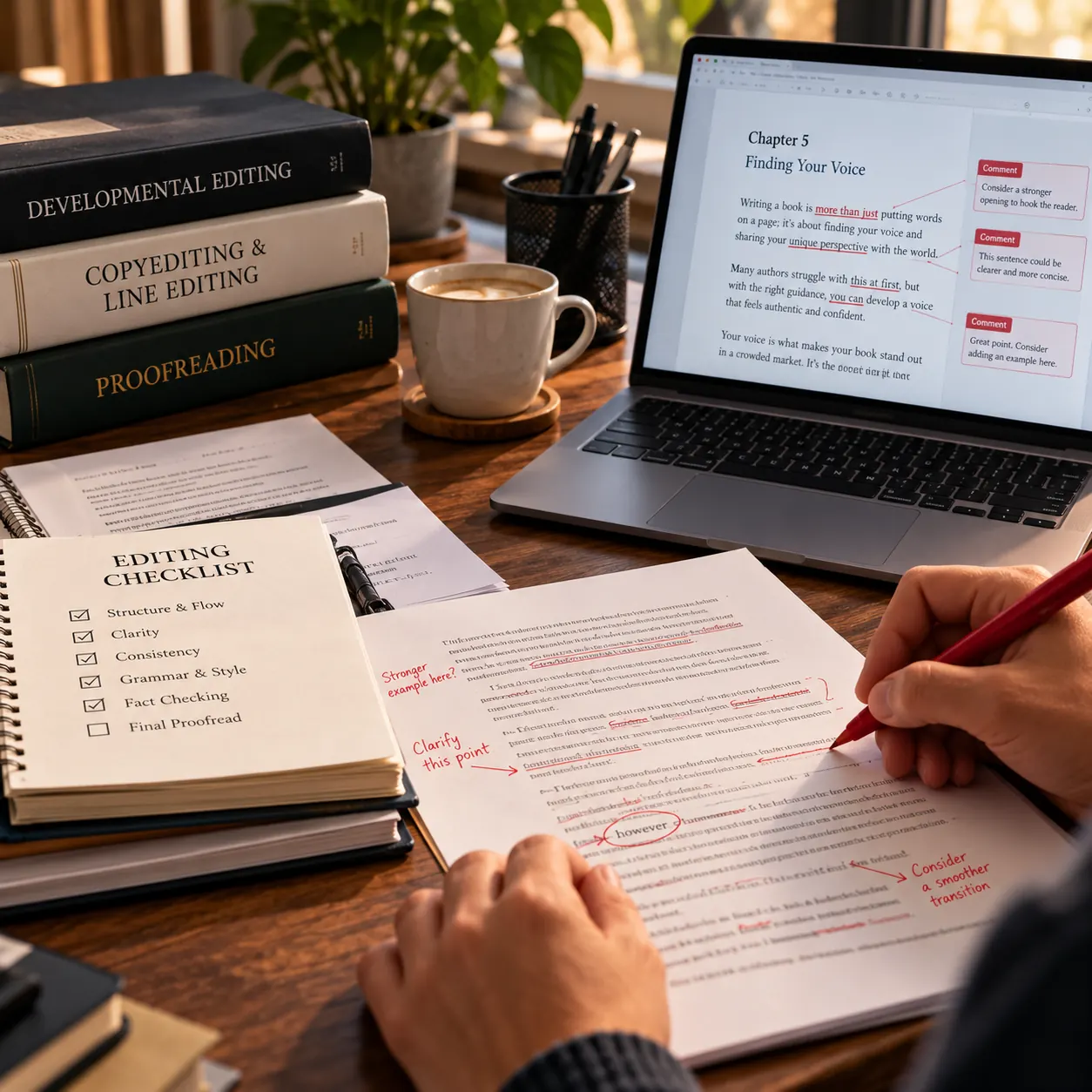
Editing is usually the largest line in a self-publishing budget, and the one with the biggest effect on reviews. Readers forgive a plain cover more easily than a book full of errors. There are three levels, and most books don’t need all of them:
- Developmental editing looks at the big picture: structure, pacing, plot or argument, character, gaps. Typical range: about $0.03–$0.08 per word.
- Copyediting / line editing fixes clarity, flow, consistency and grammar sentence by sentence. Typical range: about $0.02–$0.05 per word.
- Proofreading is the final check for typos and formatting slips before publication. Typical range: about $0.01–$0.03 per word.
For a 60,000-word book, that works out to roughly $1,800–$4,800 for a developmental edit, $1,200–$3,000 for a copyedit and $600–$1,800 for a proofread.
Where to save: If beta readers aren’t confused by the story or argument, skip the developmental edit and invest in a copyedit or a professional proofread. A clean proofread is the minimum for any book you plan to sell.
Our own proofreading starts at $180 and book editing at $600, with a written quote based on your word count.
2. Book cover design: $0 to $1,500
Your cover is your book’s advertisement. On Amazon it first appears as a thumbnail about the size of a postage stamp, beside dozens of competing titles. It has to signal the genre instantly and stay readable when tiny.
- DIY or template: free to about $50. Fine for a first draft of your vision, rarely good enough to compete.
- Premade cover: roughly $50–$200. A finished design with your title added; quick and affordable, but not unique.
- Custom ebook cover: roughly $200–$600.
- Full print wrap (front, spine and back for a paperback): usually an extra $100–$300, because the spine width depends on your final page count.
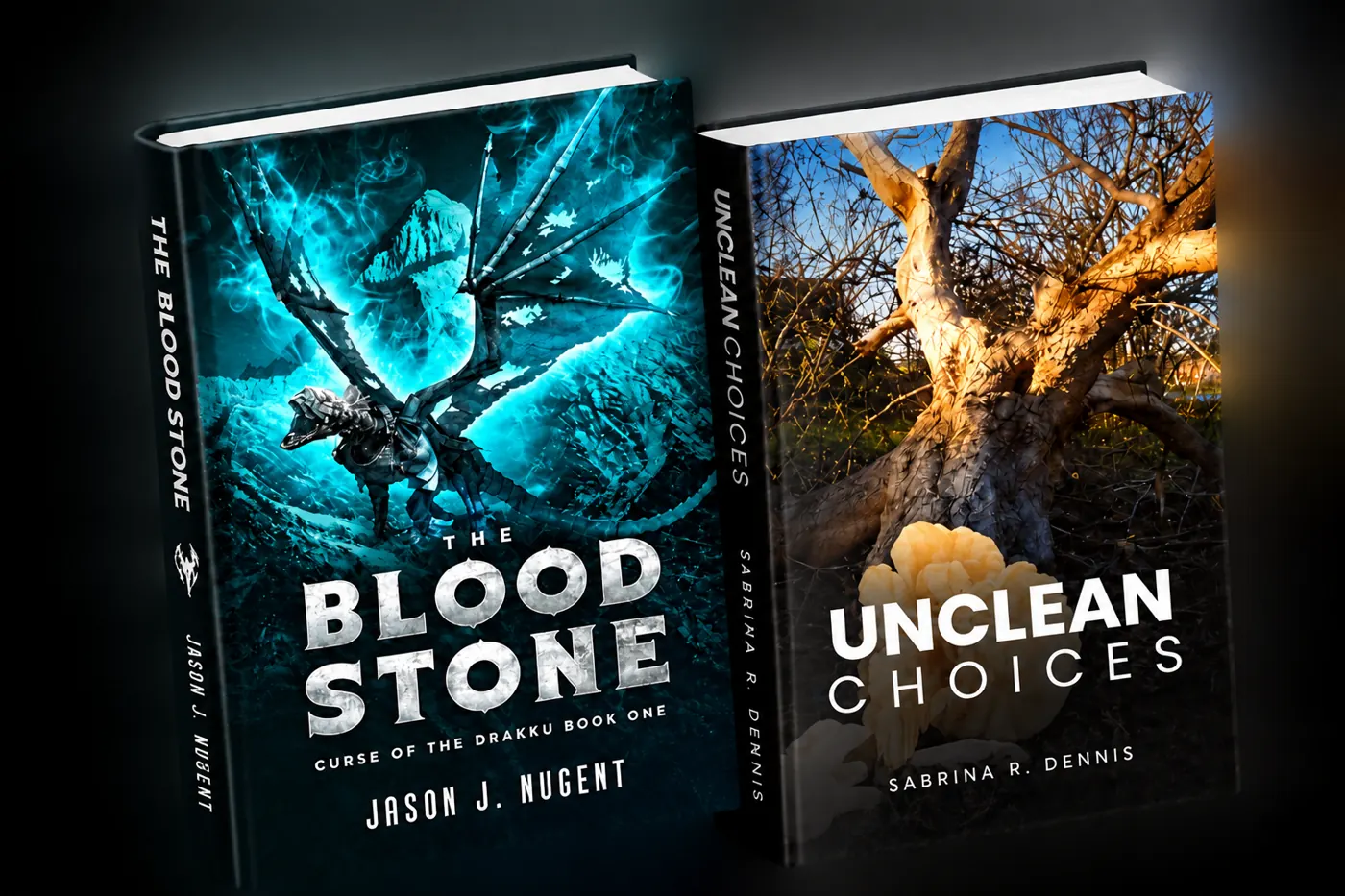
Our book cover design starts at $250, and every publishing package includes a free 3D cover.
3. Formatting and typesetting: $0 to $800
Formatting turns your manuscript into files that read well on a Kindle and print correctly as a paperback: chapter headings, margins, trim size, page numbers, a working table of contents.
- Free: Amazon’s Kindle Create handles simple, text-only books well.
- Software: tools like Vellum (Mac only, a one-time license of roughly $200–$250) produce polished ebooks and print interiors.
- Professional formatting: about $100–$300 for a standard novel or nonfiction book, more for books with images, tables, footnotes or fixed layouts.
Our book formatting starts at $150 and covers Kindle, EPUB and print-ready files.
4. ISBN and barcode: $0 to $295
An ISBN identifies a specific edition of your book. You have two options:
- Free KDP ISBN: fine for most authors who publish their paperback on Amazon. The catch: Amazon’s imprint is listed as the publisher, and that ISBN can’t be used with other printers.
- Your own ISBN: in the US, ISBNs are sold by Bowker at $125 for one or $295 for ten. Each format (paperback, hardcover, audiobook) needs its own, which is why the 10-pack is better value.
Kindle ebooks don’t need an ISBN at all. Amazon assigns its own identifier (ASIN).
5. Printing: $0 upfront
With print-on-demand you never pay a printer upfront. Amazon prints each paperback when it’s ordered and subtracts the printing cost from your royalty. According to KDP’s printing cost guidelines, a black-ink paperback is priced as a fixed cost plus a per-page cost. On Amazon.com that’s roughly $1.00 + $0.012 per page for books over 108 pages, so:
- a 200-page paperback costs about $3.40 to print
- a 300-page paperback costs about $4.60 to print
The only printing you pay for directly is author copies, which you can order at print cost plus shipping for events, giveaways and reviewers. Color interiors cost considerably more per page, so check KDP’s calculator before choosing color.
6. Marketing and launch: $0 to $3,000+
A book nobody can find doesn’t sell, however good it is. Marketing is the most flexible line in the budget, and the one where spending without a plan wastes the most money.
- Free foundations: a compelling book description, the right categories and keywords, an Amazon Author Central page, and a list of advance readers who will leave honest reviews.
- Amazon Ads: you set the budget, and many authors start with a few dollars a day to test keywords before scaling what works.
- Author website and email list: the asset that lets you sell your next book without paying for every reader again.
- Professional launch help: our book marketing starts at $500.
Where to save: Fix the listing before you buy traffic. Ads sent to a weak cover or a vague description burn money. Get the cover, description and categories right first, then test ads with a small daily budget.
7. Optional extras
- Illustrations for children’s books: often the largest cost in that genre, from a few hundred to several thousand dollars.
- Audiobook production: narration, editing and mastering, usually priced per finished hour.
- Copyright registration with the U.S. Copyright Office: a modest online filing fee (check copyright.gov for the current amount). Your work is protected by copyright as soon as it’s written; registration strengthens your position if you ever need to enforce it.
- Ghostwriting, if someone else writes the book: a different budget altogether, typically several thousand dollars and up.
Self-publishing cost calculator
Estimate your budget
Choose a level for each part of your book. Figures use the mid-point of the ranges in this guide for a book of about 60,000 words.
Three real-world budgets
Ranges are useful; examples are better. Here’s how three different authors might budget a first book.
Budget 1 · The lean launch
A 45,000-word self-help book
- Professional proofread$450
- Premade cover + print wrap$200
- Formatting (Kindle Create)$0
- Free KDP ISBN$0
- Advance readers + small ads test$100
Total ≈ $750
Budget 2 · The professional debut
A 70,000-word novel
- Copyedit + proofread$2,400
- Custom cover + print wrap$550
- Professional formatting$250
- Own ISBNs (10-pack)$295
- Launch + Amazon Ads$500
Total ≈ $4,000
Budget 3 · The done-for-you package
A finished 60,000-word manuscript
- Proofreading & editingIncluded
- Formatting & typesettingIncluded
- 3D cover, unlimited revisionsIncluded
- ISBN, barcode, top 5 platformsIncluded
- Project managerIncluded
Package $499
Budgets 1 and 2 are illustrative, built from the market ranges above. Budget 3 is our Author Choice Package; your quote depends on your manuscript.
Royalties: how many copies to break even?
Spending money only makes sense next to what the book can earn. Here’s how Amazon pays you, using the figures KDP publishes.
Ebook royalties
Kindle ebooks earn either a 35% or 70% royalty. The 70% option applies when your price falls within Amazon’s eligible price band (it starts at $2.99 on Amazon.com; check KDP’s ebook royalty page for the current upper limit) and includes a small delivery fee based on file size. A $4.99 text-only ebook earns roughly $3.40 per sale.
Paperback royalties
Paperbacks earn 60% of the list price minus the printing cost when priced at $9.99 or more on Amazon.com. Take a 250-page paperback priced at $14.99:
List price$14.99
60% royalty rate$8.99
Printing cost ($1.00 + 250 × $0.012)− $4.00
Your royalty per copy≈ $4.99
Break-even examples
- A $750 lean budget breaks even at about 150 paperbacks or about 220 ebooks.
- A $1,500 professional budget breaks even at about 300 paperbacks or 440 ebooks.
- Most authors sell a mix, and ebooks and paperbacks together reach break-even faster than either alone.
This is why the cover and the first pages matter so much: they’re what turn a browser into one of those copies. It’s also why many authors plan a second book early. A reader who enjoys book one is the cheapest reader you’ll ever find for book two.
7 ways to cut costs without cutting corners
- Get a proofread, always. If you can only pay for one service, make it this one.
- Use beta readers before a developmental edit. Five honest readers can tell you whether the structure works before you pay someone to fix it.
- Edit before you pay an editor. Every self-editing pass shortens a paid edit, and many editors charge less for clean manuscripts.
- Spend on the cover, save on the interior. Free formatting tools are good for text-only books; a weak cover costs sales on every impression.
- Use the free KDP ISBN unless you need your own imprint or wide print distribution.
- Launch organically first. Advance readers, a strong description and the right categories cost nothing. Test ads only once the listing converts.
- Compare bundles with à-la-carte prices. A package that includes editing, cover, formatting and publishing often costs less than hiring each specialist separately.
Red flags: costs you should never pay
Self-publishing services range from excellent to predatory. Before you sign, check that the company does not:
- take a percentage of your royalties, now or later
- publish your book on their account instead of yours
- keep the rights or the final files after you’ve paid
- charge thousands upfront for packages of vague “marketing” with no clear deliverables
- promise bestseller status or guaranteed sales numbers
A trustworthy service gives you a written quote, publishes under your name on accounts you control, and hands over every file. That’s exactly how we work: you keep 100% of your rights and royalties.
Skip the guesswork
Professional publishing from $199, with every royalty yours
Our publishing packages bundle proofreading, formatting, a free 3D cover, ISBN and barcode, and publishing on Amazon (plus up to 10+ stores) for one clear fee: $199, $499 or $899. Published under your name, on your account.
The bottom line
So, how much does it cost to self-publish a book? Amazon charges nothing. A book that looks and reads professionally usually costs $500 to $3,000, and you can go far lower or far higher depending on how much you do yourself.
Spend first on the things readers judge before they buy (the cover and a clean, edited text), keep your rights and royalties, and treat marketing as a test you scale only once the listing converts. Do that, and your budget becomes an investment you can actually earn back.
Ready to see what your book would cost? Tell us about your manuscript and we’ll send a free, written quote within one business day.
Frequently asked questions
Is it free to publish a book on Amazon?
Yes. Creating a Kindle Direct Publishing (KDP) account, uploading your files and listing an ebook or paperback costs nothing, and KDP offers a free ISBN for paperbacks. Amazon earns its share when a copy sells: print costs and its royalty split come out of each sale, not out of your pocket upfront. What costs money is the professional work that makes the book sell: editing, cover design, formatting and marketing.
How much does it cost to self-publish a 200-page book?
For a 200-page (roughly 50,000-word) book, a lean but professional budget is usually $500 to $1,500: proofreading, a custom ebook and paperback cover, formatting, and a modest launch. Add a full copyedit and the total moves toward $1,500–$2,500. Printing is not an upfront cost with print-on-demand; on Amazon.com a 200-page black-ink paperback costs about $3.40 to print, deducted from each sale.
Do I need to buy my own ISBN?
Not always. Kindle ebooks don’t need an ISBN, and KDP gives paperbacks and hardcovers a free one. Buy your own (in the US from Bowker: $125 for one or $295 for ten) if you want your own imprint listed as publisher or plan to distribute the same edition beyond Amazon.
How much do self-published authors earn per book?
On Amazon, ebooks priced within KDP’s 70% band earn about 70% of the list price minus a small delivery fee, so a $4.99 ebook earns roughly $3.40. Paperbacks earn 60% of the list price (at $9.99 and above) minus the print cost, so a 250-page paperback at $14.99 earns about $5. Total income depends far more on how many readers find the book than on the royalty rate.
What is the cheapest way to self-publish a book professionally?
Spend money where readers notice it first: a professional cover and a proofread. Format the interior yourself with free tools, use KDP’s free ISBN, launch with advance readers instead of paid ads, and add a copyedit if beta readers flag clarity problems. A bundled publishing package can also cost less than hiring each specialist separately.
How long does it take to earn back the cost of self-publishing?
It depends on price and sales. With a $1,200 budget, a $14.99 paperback earning about $5 per copy breaks even at roughly 240 copies; a $4.99 ebook earning about $3.40 needs roughly 350. Authors who publish more than one book usually recover costs faster, because readers who enjoy one title buy the next.
Is it worth paying a self-publishing company?
It can be, if you keep your rights and royalties and you know exactly what you are paying for. Avoid companies that take a share of your royalties, keep the files, or publish on accounts you don’t control. A good service publishes under your name, on your accounts, for a clear one-time fee.
Our editors, designers and KDP specialists publish books for independent authors every week. This guide reflects the prices and Amazon rules we work with daily, and we update it when they change. More about us.