Quick answer
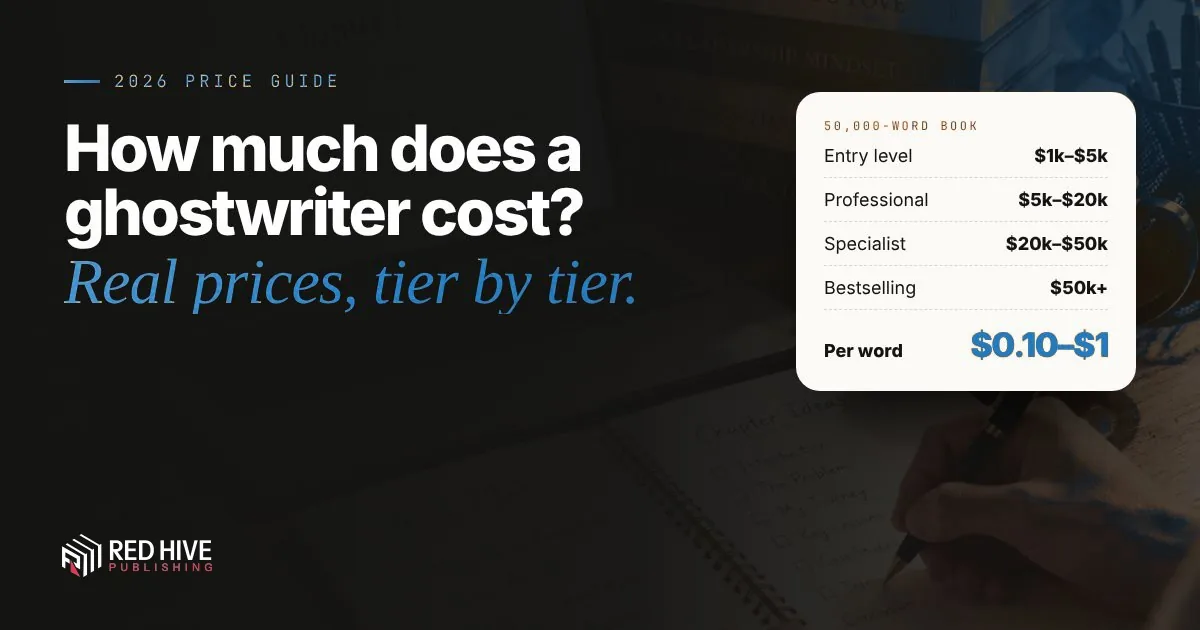
How much does a ghostwriter cost? Most professional ghostwriters charge between $0.10 and $1.00 per word, which puts a typical 40,000–60,000-word book at roughly $5,000 to $50,000. Agencies and newer writers sit at the lower end, while ghostwriters with bestselling credits often charge $50,000 to $100,000 or more. Length, research, interviews and turnaround move the price most.
Ask ten ghostwriters what a book costs and you’ll hear ten different numbers, from a few hundred dollars on freelance marketplaces to six figures for celebrity memoirs. Both can be honest prices for very different work. This guide explains what each tier actually buys, what drives a quote up or down, and the contract terms that make sure the book, the credit and the royalties end up with you.
Key takeaways
- Published rate guides put most book ghostwriting between $0.10 and $1.00 per word; elite writers charge more.
- Book projects are usually priced as a fixed fee paid in milestones, not an open-ended per-word bill.
- Length, research and interviews move the price more than genre does.
- Editing, cover design and publishing are often not included, so compare complete budgets, not headline prices.
- Your contract should give you the copyright, the credit and 100% of royalties, in writing.
Ghostwriter cost at a glance
These ranges come from published rate guides and freelance marketplaces in 2026. They’re planning figures, not quotes; your price depends on the book.
| Tier | Per word | 50,000-word book | Best for |
|---|---|---|---|
| Marketplace / entry level | $0.02–$0.10 | $1,000–$5,000 | Short guides and ebooks with clear outlines |
| Professional / agency team | $0.10–$0.40 | $5,000–$20,000 | Most memoirs, business books and novels |
| Experienced specialist | $0.40–$1.00 | $20,000–$50,000 | Research-heavy or high-stakes books |
| Bestselling / celebrity | $1.00+ | $50,000–$100,000+ | Books with major publisher deals |
Ranges compiled from public rate guides, including Reedsy’s ghostwriter cost guide and the Editorial Freelancers Association rate chart. Sources differ, so treat them as a guide to the market, not fixed prices.
How ghostwriters charge
You’ll usually see one of four pricing models. Knowing which one you’re being offered makes quotes easier to compare.
Flat project fee
The most common model for books. You agree a total for a defined scope (word count, number of interviews, rounds of revision) and pay in milestones, for example a deposit, payments as chapters are approved, and a final payment on delivery. It’s the easiest model to budget for, and the one we recommend asking for.
Per word
Common for shorter projects and with freelancers. It’s transparent, but the final bill depends on the final length, and books often run longer than planned. If you accept a per-word rate, agree a word-count ceiling.
Per hour
Hourly rates (often $35 to $200+) are more typical for editing, rewriting a messy draft or consulting. For a full book, hourly billing makes the total hard to predict.
Lower fee plus royalties
Some established ghostwriters take a reduced upfront fee in exchange for a share of sales. It can lower your initial cost, but it means sharing income from your book for years. Only agree to it deliberately, with the percentage, the formats and the duration written into the contract.
5 things that change the price

1. Length
Word count is the starting point of every quote. A 20,000-word lead-magnet ebook and a 90,000-word novel are completely different projects. Typical lengths: short business ebooks 15,000–30,000 words, most nonfiction and memoirs 40,000–70,000, novels 70,000–100,000.
2. Research and source material
A book built from your existing blog posts, talks or a detailed outline costs less than one that needs primary research, fact-checking or historical accuracy. Biographies and technical books cost more for this reason.
3. Interviews
Memoirs and business books are written from conversations with you, and sometimes with family members, colleagues or clients. More interviews mean a richer book and a higher fee. Our memoir writing service, for example, is built around a structured interview plan.
4. Genre and voice
Fiction needs plot, structure and character work; nonfiction needs clear argument and evidence. Neither is “cheaper” in itself, but matching an experienced writer to your genre is worth paying for, because rewriting a book in the wrong voice costs more than getting it right.
5. Turnaround
Most books take two to six months. Need it in six weeks for a launch or a conference? Expect a rush premium, because the writer has to clear other work.
What’s included (and what usually isn’t)
Two quotes for “a 50,000-word book” can cover very different work. Before you compare prices, check each line:
| Item | Usually included? | What to ask |
|---|---|---|
| Outline and chapter plan | Yes | Do I approve it before writing starts? |
| Interviews | Often, limited | How many, and how long each? |
| Revisions | Yes, limited | How many rounds per chapter, and what counts as a revision? |
| Professional editing | Often not | Is a separate editor or proofreader included? |
| Cover, formatting, publishing | Rarely | Can you quote these, and on whose account is the book published? |
| Copyright and files | Should be | Is copyright assigned to me on payment, and do I get every file? |
Editing deserves a special mention. Even a strong ghostwriter benefits from a second set of eyes, and a proofread is the minimum before publishing. If a quote leaves editing out, add professional book editing to your budget before you compare.
Sample budgets
A 25,000-word business ebook
Built from your talks and notes, with three interviews. Agency or professional tier: roughly $2,500–$7,500. Add proofreading, a cover and publishing if you want it on Amazon.
A 55,000-word family memoir
Eight to twelve interviews, photos and family records, light research. Professional tier: roughly $8,000–$20,000, more with an experienced specialist.
An 80,000-word novel
From your plot idea and character notes, with an approved outline. Professional tier: roughly $10,000–$30,000. Series pricing is often lower per book.
Illustrative ranges based on the tiers above, not quotes. Every project is priced on its own scope.
Ghostwriter, book coach or editor: which do you need?
A ghostwriter isn’t the only way to get a book written, and the cheapest option is the one that matches how much of the writing you want to do yourself.
| Option | Who writes | Typical cost | Choose it when |
|---|---|---|---|
| Ghostwriter | The writer, from your ideas and interviews | Highest | You have the story or expertise but not the time or writing confidence |
| Book coach | You, with structured guidance | Medium, usually monthly | You want to write it yourself and need accountability and structure |
| Developmental editor | You; the editor restructures and advises | Medium | You already have a full draft that isn’t working yet |
| Copyeditor or proofreader | You; the editor polishes | Lowest | The draft is finished and you need it clean and consistent |
Many authors combine them: a ghostwriter for the first draft of a memoir, then a separate proofread before publishing. If you have a complete draft already, a ghostwriter is usually the wrong (and most expensive) tool. Editing is the better investment.
10 questions to ask before you hire
A short call answers most of what matters. Ask every ghostwriter or agency you’re considering:
- Can I see samples in my genre, or speak to a past client?
- How will you capture my voice: interviews, recordings, my own writing?
- What exactly does the quote include, and what costs extra?
- Is the price fixed, and what would change it?
- How is payment split across milestones?
- How many revision rounds are included per chapter?
- Who will actually write the book, and will that person change during the project?
- Will I own the copyright, and is that written into the contract?
- Do you use AI to write drafts, and if so, how?
- What happens if I want to stop partway through?
Clear, specific answers are a good sign. Vague ones about ownership, revisions or who does the writing are worth more weight than the price.
Contract terms that protect you
Price matters, but the contract decides who owns the result. Make sure yours covers:
- Copyright assignment. In the US, a commissioned book usually isn’t automatically a “work made for hire” (see the US Copyright Office guide to works made for hire), so the contract should assign the copyright to you in writing, effective when you pay.
- Credit. State whether the writer stays anonymous or gets an “as told to” or “with” credit. Most ghostwriting is uncredited.
- Royalties. Confirm the fee is the writer’s full payment and that every royalty is yours, unless you’ve deliberately agreed a share.
- Confidentiality. A signed NDA before you share your story or business details.
- Originality. A promise that the text is original, not copied, recycled or generated wholesale by AI.
- Milestones and revisions. What you pay at each stage, what you approve, and how many revision rounds are included.
- Files and termination. You receive all drafts and files, and you keep the work completed so far if the project ends early.
Red flags when hiring a ghostwriter
- A price that’s far below the market for a full-length book, with no explanation of how it’s possible
- No samples in your genre, or samples they can’t show for confidentiality reasons and no other proof of work
- Full payment upfront instead of milestones
- Vague answers about who owns the copyright, or a royalty share hidden in the small print
- No plan for interviews or capturing your voice
- Promises of bestseller status or guaranteed sales
Know your price before you commit
Ghostwriting from $2,400, in your voice and under your name
Tell us about your book and we’ll send a written, fixed quote. Every project includes a signed NDA, an outline you approve, chapter-by-chapter reviews, and a writer matched to your genre. You keep 100% of your rights and royalties.
How to lower the cost without lowering quality
- Bring material. Notes, recordings, old blog posts and a rough outline all shorten the writer’s work.
- Be decisive in reviews. Clear, prompt feedback keeps the project inside the agreed revision rounds.
- Pick the right length. A focused 35,000-word book often serves readers better than a padded 70,000-word one.
- Bundle the next steps. Editing, cover, formatting and publishing from one team usually cost less than hiring each separately. See our publishing packages, which start at $199.
- Plan the whole budget. Our guide to self-publishing costs covers everything after the manuscript, and how to publish a book on Amazon walks through the launch.
The bottom line
So, how much does a ghostwriter cost? For most authors, a professionally ghostwritten book costs between $5,000 and $50,000, depending on length, research, interviews and the writer’s experience. Quotes far outside that range can be legitimate, but ask what you’re getting.
Compare complete scopes, not headline prices, and don’t sign until the contract gives you the copyright, the credit and every royalty. Want a fixed number for your book? Tell us about your project and we’ll send a free, written quote within one business day.
Frequently asked questions
How much does a ghostwriter cost for a 50,000-word book?
Published rate guides put most professional ghostwriters between about $0.10 and $1.00 per word, so a 50,000-word book typically lands between $5,000 and $50,000. Newer writers and agencies with in-house teams sit at the lower end; ghostwriters with bestselling credits often charge $50,000 or more. Ask for a fixed project quote rather than an open per-word rate, so the total can’t drift.
Why are some ghostwriters so cheap?
Very low prices usually mean one of three things: the writer is new, the book is short or mostly assembled from your own material, or corners are being cut, for example AI-generated drafts, recycled content or no interviews. Check samples in your genre, ask how the writer will capture your voice, and make sure the contract confirms original work and full rights for you.
Do ghostwriters get royalties?
Usually not. Most ghostwriters are paid a flat project fee and have no claim on sales. Some high-profile writers accept a lower fee plus a share of royalties, but that should be your choice and spelled out in writing. With us, the writer is paid the agreed fee and you keep 100% of your rights and royalties.
Who owns the copyright to a ghostwritten book?
You should, but only if the contract says so. In the US, a commissioned book is not automatically a “work made for hire”, so the agreement should include a written assignment of copyright to you, effective on payment. Also confirm you receive all drafts and files and that the writer can’t reuse the material.
How long does it take a ghostwriter to write a book?
Most full-length books take two to six months, depending on length, research and how quickly you review chapters and join interviews. Our ghostwriting projects typically run 8–14 weeks from the first strategy session to the final manuscript.
Is it worth paying for a ghostwriter?
It is worth it when the book has a clear job: building authority for a business, preserving a family story, or finally finishing a novel you’ve planned for years. Price the whole project, including editing, cover and publishing, and compare it with what the book needs to achieve. A well-written book you actually publish is worth more than a cheap draft you never use.
Do I still need an editor if I hire a ghostwriter?
Usually yes, at least a proofread. Ghostwriters revise their own drafts, but a separate editor catches what the writer can no longer see. Many ghostwriting quotes exclude professional editing, so ask whether it is included before you compare prices.

Our editors, designers and KDP specialists publish books for independent authors every week. This guide reflects the prices and Amazon rules we work with daily, and we update it when they change. More about us.