Quick answer
How to write a memoir: choose one theme or turning point (not your whole life), list the memories that serve it, pick a structure, then write it as scenes with dialogue and detail, reflecting on what each moment meant. Be honest but careful with real people, finish a full draft before polishing, and get it edited before you publish.
Most people who start a memoir stall in the same place: they try to fit their entire life into one book, then drown in memories. The memoirs readers love do something different. They tell one story from a life, with a clear question at its heart, and they let a stranger feel what it was like to be there. This guide walks you through that process, from finding your focus to holding the finished book.
Key takeaways
- A memoir is one story from your life, not your whole life story.
- Readers connect through scenes and reflection, not summaries of what happened.
- You don’t have to write in order. Structure serves the story.
- Write about real people truthfully and carefully; change details where needed.
- Finish the draft first, then revise and edit.
Memoir vs autobiography: know what you’re writing
| Type | Scope | Written by |
|---|---|---|
| Memoir | One theme, period or experience, explored in depth | You (or a ghostwriter in your voice) |
| Autobiography | Your whole life, usually in order | You (or a ghostwriter in your voice) |
| Biography | Someone else’s life | A third person, often with research and interviews |
If you want to record your whole life for your family, an autobiography may fit better. If one chapter of your life changed you and could help or move other people, that’s a memoir.
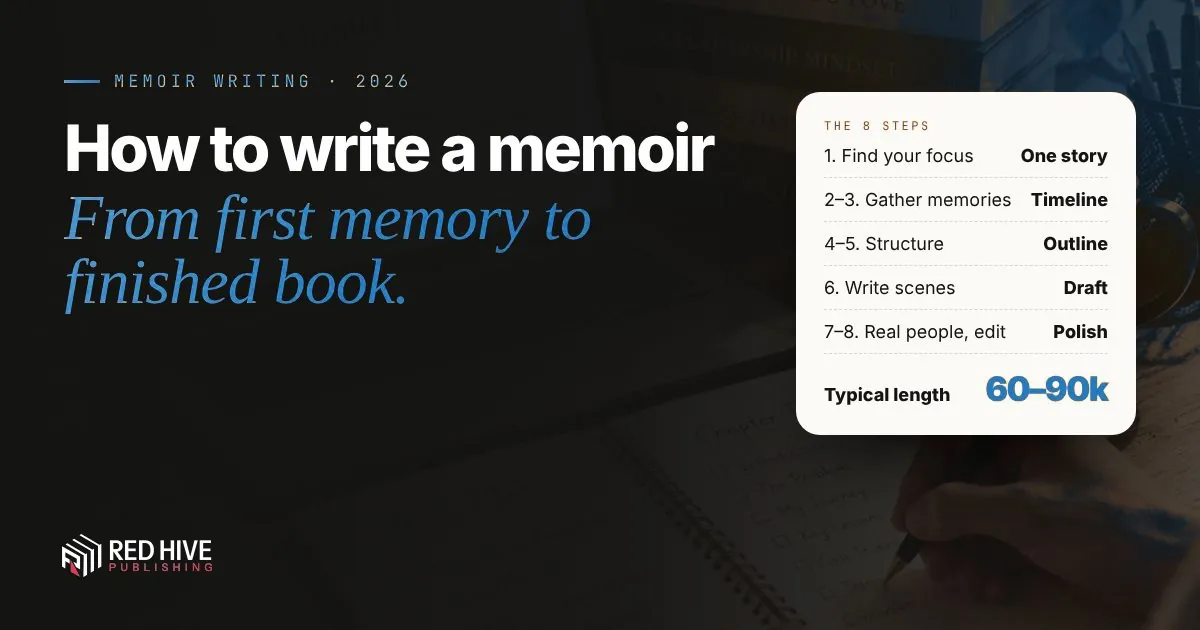
How to write a memoir in 8 steps
1. Find your focus and your question
Ask yourself: what happened that changed me, and what did I learn? A strong memoir usually centers on one transformation: leaving a career, surviving an illness, raising a child with special needs, rebuilding after loss, or building a business from nothing. Try to sum it up in one sentence, for example: “How losing my business taught me what success actually means.” That sentence becomes your filter for every memory.
2. Know who you’re writing for
Writing for your grandchildren is different from writing for strangers in a bookshop. A family memoir can include more names, places and context. A memoir for a wider audience needs a story that matters to people who have never met you, so every chapter has to earn its place.
3. Gather your memories
Before outlining, collect raw material. Make a timeline of the period you’re writing about, then go through photos, letters, journals, emails, social media posts and old documents. Talk to people who were there; they’ll remember details you’ve forgotten. Jot down every scene that comes to mind, without judging yet.
Tip: record yourself telling the stories out loud. Many people speak more naturally than they write, and a recording captures your real voice, the voice your memoir should sound like.
4. Choose a structure
You don’t have to start at the beginning. Common memoir structures include:
- Chronological: simple and clear, best for stories with a strong forward momentum.
- Frame or flashback: open at a dramatic moment, then go back to show how you got there.
- Braided: two timelines (for example, then and now) alternate and meet at the end.
- Thematic: each chapter explores one theme or lesson, useful for reflective or advice-led memoirs.
Whatever you choose, the story needs a clear beginning, a middle where things get harder, and an ending where something has changed.
5. Outline your chapters
Pick the 20 to 40 scenes that best show your transformation and arrange them in your chosen structure. For each chapter, note what happens, what you felt then, and what you understand now. That last part, reflection, is what turns a list of events into a memoir.
6. Write scenes, not summaries

“My father was strict” is a summary. A scene shows him checking your homework at the kitchen table, the clock ticking, the red pen. Use the senses, dialogue (as close as you can remember it) and specific details to put readers in the room. Then step back and reflect: what did that moment mean, then and now?
- Write the first draft fast. Don’t edit as you go; aim to finish.
- Set a routine: 500 words a day adds up to a 60,000-word draft in about four months.
- Be honest about yourself, including your mistakes. Readers trust narrators who don’t make themselves the hero of every scene.
7. Write about real people carefully
Memoirs are full of real people, and that brings responsibility. These are general principles, not legal advice:
- Tell the truth as you experienced it, and keep facts separate from your opinions and feelings.
- Change names and identifying details of private individuals when the story doesn’t need them, and note it in an author’s note.
- Think about privacy, not just accuracy. Revealing someone’s private information can hurt them even if it’s true.
- Talk to the people involved where you can. Some will be glad to be included.
- Get legal advice from a publishing or media lawyer for anything that could damage someone’s reputation. The law varies by country.
8. Revise and edit
Put the finished draft away for a few weeks, then read it as a stranger would. Cut scenes that don’t serve your central question, tighten the opening, and make sure the ending lands. Then get outside help: beta readers for reactions, a professional editor for structure and prose, and a proofreader before publishing. Memoirists are almost always too close to their story to edit it alone.
How long should a memoir be?
| Type | Word count | Approx. pages (6 × 9) |
|---|---|---|
| Family or legacy memoir | 30,000–60,000 | 120–240 |
| Focused personal memoir | 50,000–70,000 | 200–280 |
| Full-length trade memoir | 70,000–90,000 | 280–360 |
Page counts vary with font, layout and trim size.
Your story, written for you
Memoir writing from $2,200, in your own voice
A memoir ghostwriter interviews you, organizes your memories and writes the book chapter by chapter, with your approval at every step. Every project includes a signed NDA, and you keep the credit, the copyright and 100% of your royalties.
12 memoir prompts to get you writing
Stuck on the blank page? Pick one prompt, set a timer for 20 minutes and write without stopping. Many of these will turn into scenes in your book.
- The moment you realized life would never be the same.
- A room from your childhood, described so a stranger could walk through it.
- The hardest conversation you ever had, and what you wish you’d said.
- A decision you almost didn’t make.
- The person who believed in you before you believed in yourself.
- A smell, song or object that takes you straight back to that time.
- The day you failed, and what happened the next morning.
- Something you’ve never told anyone, and why you kept it quiet.
- A rule your family lived by, and when you first broke it.
- The first time you felt truly proud of yourself.
- What you would tell your younger self at the start of this story.
- Where you are now, and what you finally understand.
Don’t worry about order or quality at this stage. The aim is to get memories onto the page, so you can see which ones belong in the book and which ones were only part of the journey.
Common memoir mistakes
- Trying to tell your whole life. Choose one story and go deep.
- Summarizing instead of showing. Readers need scenes they can step into.
- No reflection. Events alone aren’t a memoir; meaning is.
- Settling scores. Readers notice when a memoir is a weapon, and they stop trusting the narrator.
- Editing while drafting. Finish first; perfectionism stops more memoirs than anything else.
- Publishing without an edit. A personal story deserves a professional finish.
Write it yourself or work with a ghostwriter?
Write it yourself if you enjoy writing, have the time and want every sentence to be your own. Work with a ghostwriter if you have the story but not the time, or if writing is the part holding you back. A good memoir ghostwriter captures your voice through interviews, so the finished book still sounds like you. Our guide to ghostwriter costs explains what to expect, and our memoir writing service starts from $2,200.
From finished memoir to published book
Once the manuscript is edited and proofread, you’ll need a cover, a formatted interior and an ISBN for print. Our guide to publishing a book on Amazon walks through every step, and our publishing packages handle formatting, a free 3D cover and upload from $199.
The bottom line
Learning how to write a memoir comes down to focus and honesty: choose one story from your life, gather the memories that serve it, write them as vivid scenes with reflection, treat real people fairly, and finish the draft before you polish it. Then get it edited, and share it with the readers who need it.
Ready to tell your story, with or without a ghostwriter? Tell us about your memoir and we’ll send a free, written quote within one business day.
Frequently asked questions
What is the difference between a memoir and an autobiography?
An autobiography tells your whole life story, usually in order from birth to the present. A memoir focuses on one theme, period or experience, such as a career, an illness, a relationship or a turning point, and explores what it meant. You only write one autobiography, but you could write several memoirs.
How long should a memoir be?
Most published memoirs are roughly 60,000 to 90,000 words, which is about 240 to 360 printed pages. Shorter memoirs of 40,000 to 60,000 words work well for focused stories and family histories. Length should follow the story: cut anything that doesn’t serve your central theme.
Do I have to write my memoir in chronological order?
No. Many memoirs open at a dramatic moment and then move back in time, or weave two timelines together. What matters is that readers always know where they are and that the story builds toward a clear ending.
Can I write about my family in a memoir?
Yes, but carefully. Write the truth as you experienced it, keep clear what is fact and what is your opinion, consider changing names and identifying details of private people, and think about how they’ll feel. For anything that could be damaging, get advice from a lawyer who knows publishing law in your country.
How long does it take to write a memoir?
Many first-time authors take one to two years to write and revise a memoir on their own, writing part-time. With a ghostwriter who interviews you and drafts the chapters, a memoir typically takes a few months.
Can someone write my memoir for me?
Yes. A memoir ghostwriter interviews you, organizes your memories and writes the book in your voice, while you keep the credit, the copyright and the royalties. Our memoir writing service starts from $2,200, with a written quote for your project.
Do I need an editor for a memoir?
Almost always. Memoirists are too close to their own story to see what’s missing or what drags. A developmental edit helps with structure and focus, and a proofread is the minimum before you publish.

Our editors, designers and KDP specialists publish books for independent authors every week. This guide reflects the prices and Amazon rules we work with daily, and we update it when they change. More about us.